
We are system integration experts.
We facilitate your firm’s success through custom software implementations that continually deliver relevant information and intelligence to each of your teams’ systems.
We will build custom integrations between any two systems that have APIs!
There is no implementation fee to connect two systems together, even if we’ve never worked with them previously. Here are a few of the companies that we can integrate with:
























Customize the solution to meet your needs
All of our integrations are completely custom. To date we have yet to meet two clients that operate the same way, and we’ve structured our pricing and built our architecture to accommodate anything you can dream while not being penalized for a custom solution.
Our Two-Way Synchronization System
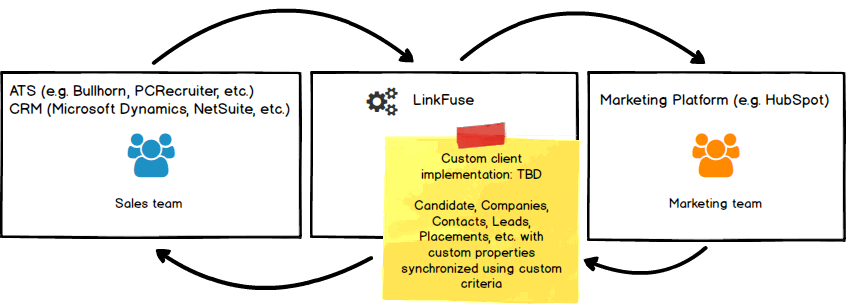
Our customizable two-way synchronization service integrates your records from one system to another using custom criteria that you provide. For example, if you were looking to connect your applicant tracking system, Bullhorn, to your marketing platform, HubSpot, you would simply define the parameters around which contacts you would like to synchronize (last added in the past 2 years, status is active, etc.) and layout the properties that you would like to track. We would then setup everything that is needed to ensure that you have a constant flow of contacts ready for your marketing team to leverage within HubSpot. Additionally, as leads naturally flow into HubSpot through forms on your website, we can push these to Bullhorn (or any third party platform) to ensure that sales has relevant leads to follow.
Let your teams work in their environment
Our integrations mean that your employees can work in their respective environments, share the intelligence between the systems, and improve their efficiency – making their jobs easier.
New System Integrations
If you do not see a platform listed here that you are using, reach out to us and, if possible, we will build a custom integration between your systems free of charge – you would just be responsible for the monthly fees as part of our normal billing cycle.